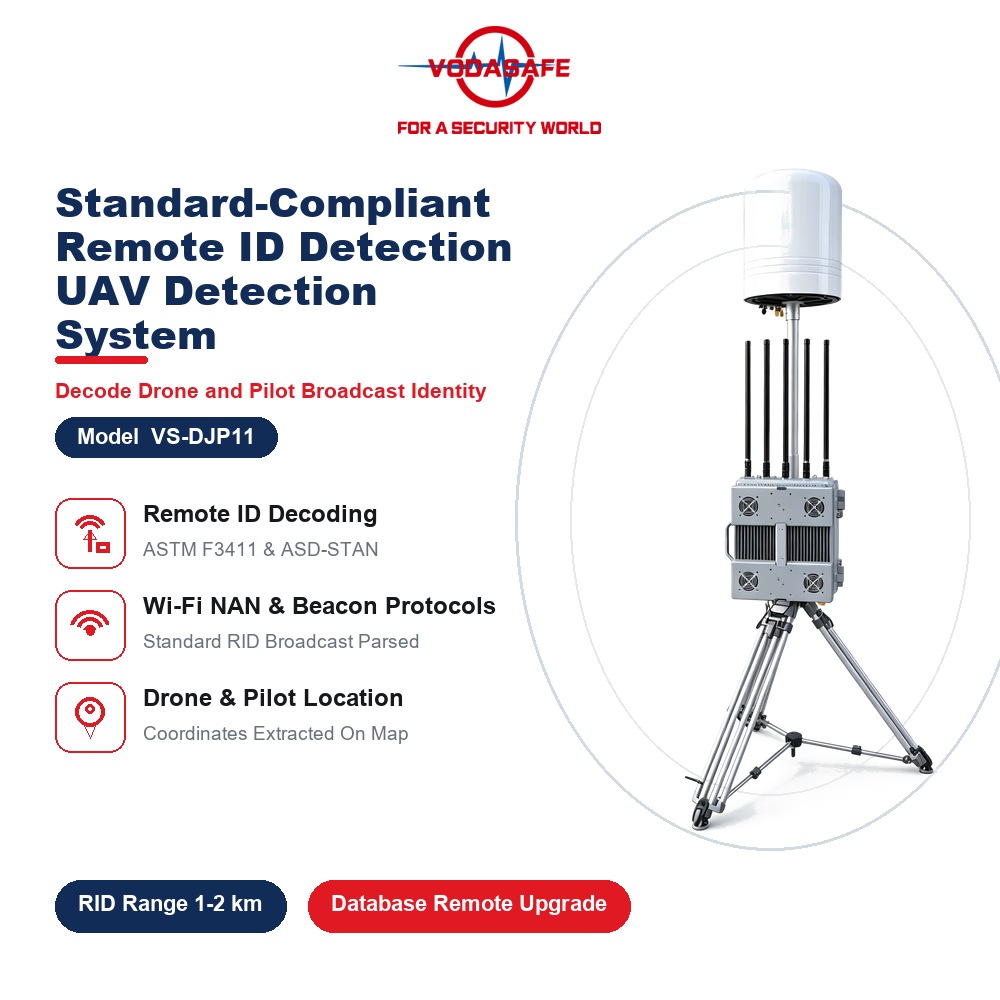
Vodasafe VS-DJP11 Integrated Drone Detection, Direction-Finding, Localization and Precision Countermeasure System
Every detection workflow operates on passive radio-frequency reception: the station never emits surveillance signals, produces no electromagnetic pollution for surrounding communication facilities, and complies with electromagnetic environment management requirements. The system provides both precision targeted countermeasure and full-band wide-area modes, so operators can apply differentiated disposal to cooperative authorized drones and to uncooperative unauthorized intruders.
A single VS-DJP11 station tracks multiple drone targets at the same time, outputs real-time longitude and latitude of both airborne drones and their ground remote controllers, and keeps continuous flight trajectory records for post-event traceability. Once countermeasure is enabled, the system cuts the remote-control downlink and the video-transmission uplink, forcing the intruding UAV to return to its takeoff point or hover for manual interception by on-site security personnel. The station supports portable tripod rapid deployment and fixed steel-frame installation, delivering 24-hour, all-weather, 360-degree omnidirectional low-altitude protection for permanent sites and temporary events alike.
Core Advantages
· Passive zero-emission detection: no surveillance radiation, no interference with nearby base stations, broadcast equipment or civilian wireless devices.
· All-in-one detection, direction finding, localization and countermeasure in one station: smaller deployment footprint and simpler wiring.
· Large target capacity: detection of 30 or more swarm drones, simultaneous direction finding of 5 UAVs, parallel precision countermeasure against 25 intruders.
· Differentiated disposal logic: targeted suppression isolates selected illegal drones while protecting whitelisted legal aircraft; wideband mode clears the airspace in emergencies.
· Strong environmental adaptation: IP66 ingress protection and continuous outdoor operation from −40 °C to +55 °C.
· Open platform: web-based operation, six-language interface, multi-source and offline maps, open API for city-level networked supervision.
· Complete identity and evidence chain: SN recognition, Remote ID decoding, flight tracks, four log categories and trajectory playback for audit and traceability.
· Flexible deployment and service: tripod or fixed frame, two operators in about 30 minutes, 24-month warranty, firmware and drone-library upgrades, OEM/ODM customization.
Full-Spectrum Detection and Intelligent Identification
The detection unit scans the ultra-wide spectrum from 100 MHz to 6 GHz, covering the frequency bands used by mainstream consumer drones and modified FPV platforms worldwide. Its built-in drone model database stores recognition information for more than 1,000 UAV types and remains compatible with DJI, Autel Robotics, Dahua and Yuneec aircraft, self-assembled FPV racing drones and common Wi-Fi small UAVs.
· Multi-dimensional real-time signal parsing: unique equipment serial number (SN), brand and model, frequency bandwidth, altitude, horizontal speed, takeoff coordinates and current flight path.
· Independent SN identity recognition distinguishes each physical drone and separates authorized units from blacklisted intruders.
· FPV decoding: analog and digital FPV transmission from custom-built drones can be decoded and restored as real-time flight images on the operation platform.
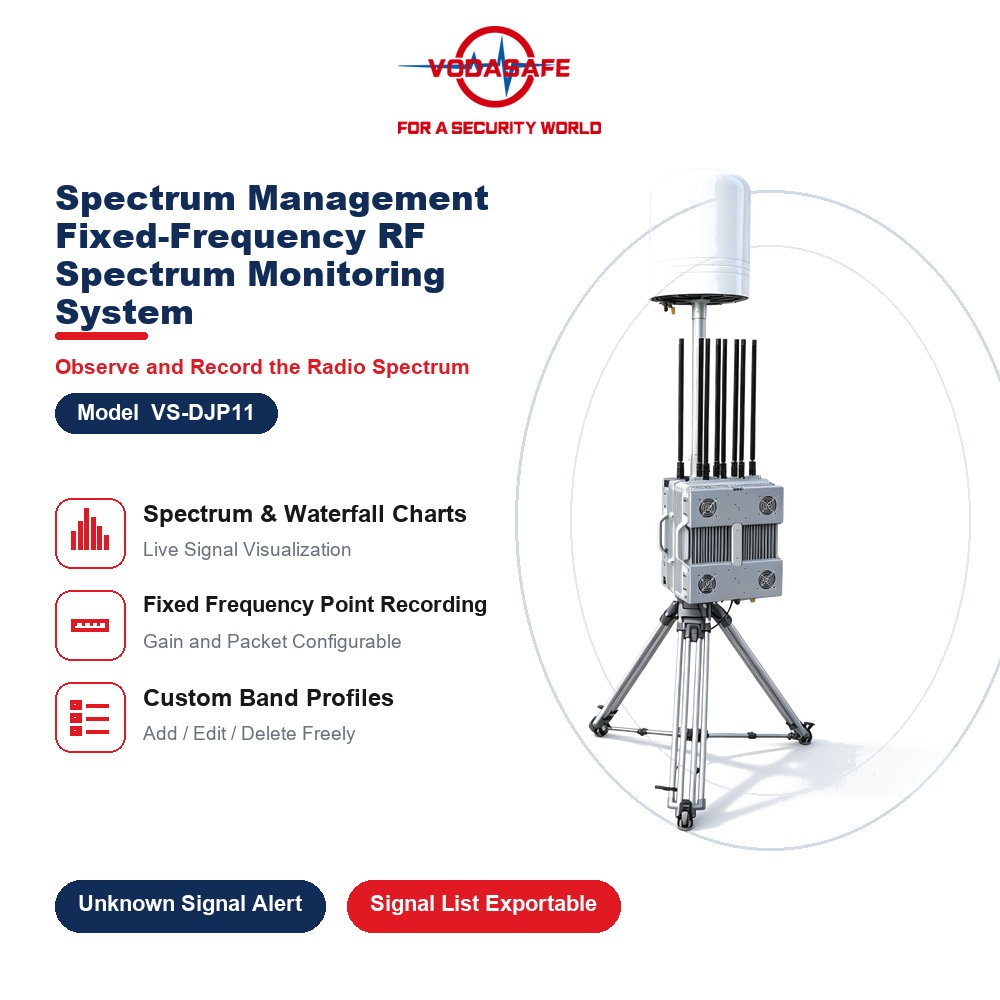
· Remote ID compliance: supports ASTM F3411, ASD-STAN prEN 4709-002 and China national standard GB42590-2023; decodes RID broadcast data to obtain drone and pilot location; supports Wi-Fi NAN and Wi-Fi Beacon protocols.
· Expandable Wi-Fi drone model library: new UAV products can be recognized through firmware updates without hardware replacement.
· Spectrum management: manual fixed-frequency recording with configurable gain and packet parameters, editable frequency profiles, and automatic identification of unknown abnormal signals.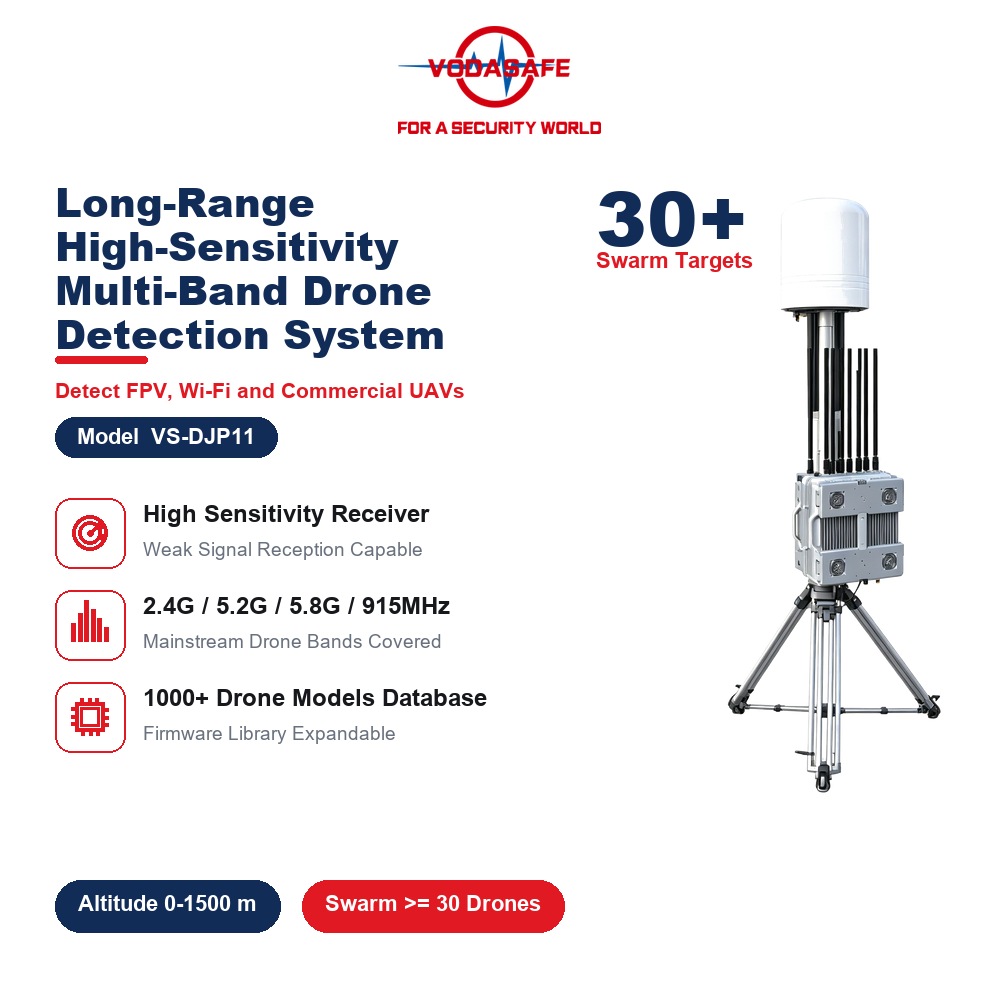
Direction Finding and High-Precision Localization
In open, unobstructed environments the effective direction-finding distance exceeds 3.5 km; up to five drone targets can be tracked simultaneously, with direction-finding accuracy within 1 degree RMS and a position refresh interval under 2 seconds for smooth real-time rendering on the GIS map.
· Single-station independent localization without multiple synchronized units; positioning error within 5 meters under ideal signal conditions.
· Separate calculation and display of geographic coordinates, azimuth and straight-line distance for the drone pilot holding the remote controller.
· One-click QR-code navigation: location links can be scanned by mobile phones to guide patrol teams directly to the pilot position.
· Up to five independent flight trajectories recorded and displayed simultaneously for multi-intrusion scenarios.
· Real-time signal strength, model, frequency and identity information shown alongside position, speed and altitude.
Selective Precision and Wideband Countermeasure
The countermeasure unit carries four independently controllable transmitting channels over 915 MHz, 2.4 GHz, 5.2 GHz and 5.8 GHz, each delivering stable average output power of 42±2 dBm. Any single channel or channel combination can be selected according to the detected drone signal characteristics.
· Precision targeted mode isolates designated single or multiple illegal drone signals without wide-area suppression; whitelisted authorized drones keep operating normally.
· Precision mode supports parallel countermeasure against at least 25 drone targets; effective range from 0.5 km to 2 km depending on terrain and shielding.
· Wideband omnidirectional mode activates all four channels at once for emergency rapid airspace clearance, applying blanket suppression to drone communication links within coverage.
· Response delay after target confirmation is under 2 seconds for instantaneous link cut-off.
· Countermeasure targets the remote-control downlink and the high-definition video uplink; communication between UAV and ground station is broken to trigger automatic return-to-home, or the drone hovers for manual interception.
· Two unattended schemes: precision unattended mode locks only blacklisted intruders while protecting whitelist units; wideband unattended mode clears the full airspace once any drone signal appears.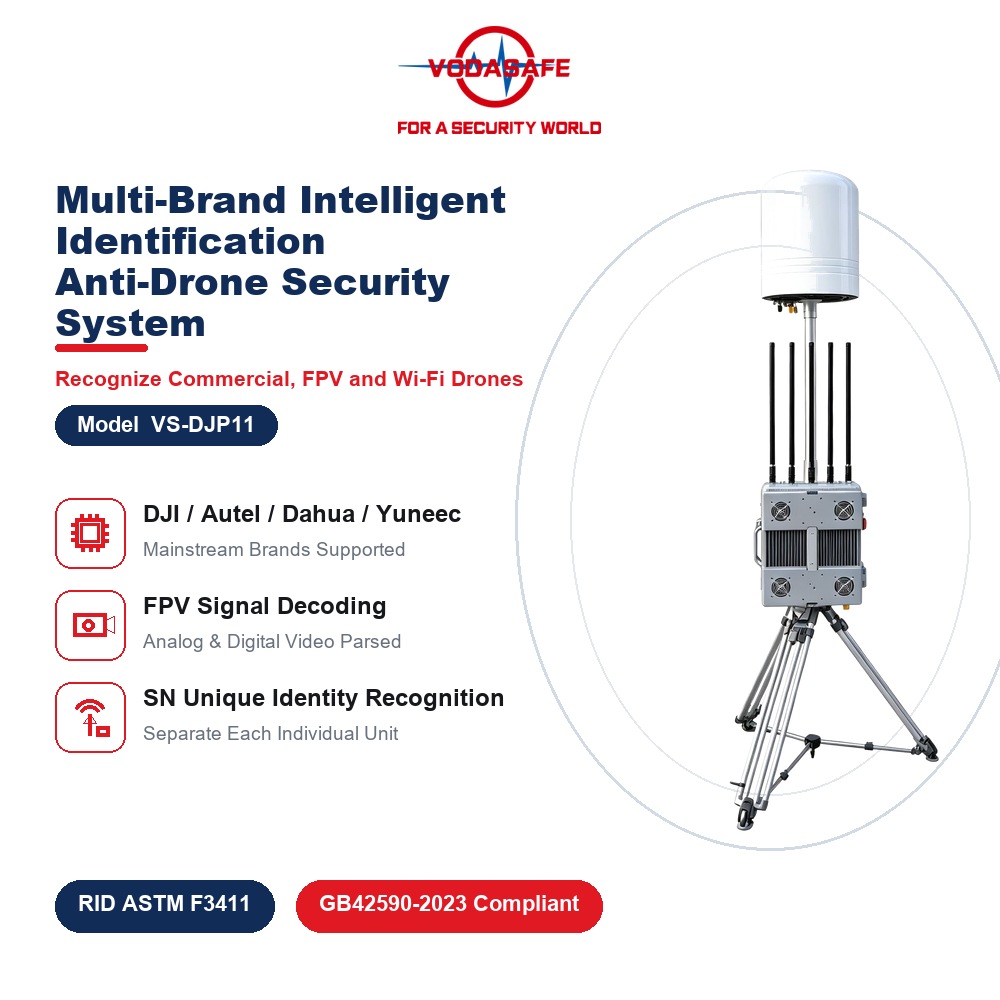
Web Operation Platform and Data Management
The VS-DJP11 uses an embedded web architecture: after the station and the workstation are connected to the same network, operators open any standard browser and enter the device IP address followed by port 7001; no dedicated client software needs to be installed.
· Six interface languages: Chinese, English, Russian, French, Arabic and Spanish; role-based permissions for Administrator, User and Guest with configurable menu access.
· Multi-source maps: Amap, Google Maps and Bing Maps, with offline map download and import for disconnected areas; distance measurement, coordinate extraction, electronic fence, track clearing and zoom tools.
· Four log categories: detection records, countermeasure records, unattended operation logs and historical flight-path playback; multi-dimensional data stored long term and filterable for security audit.
· Blacklist and whitelist batch import/export, model addition and deletion, ignore list for false-alarm filtering, NTP synchronization, dual-network-card IP and DHCP configuration.
· Standard open API for docking with city-level unified low-altitude supervision platforms and multi-device networked coordinated control; one-click factory reset, equipment self-inspection and remote restart.
· Configurable audio and flashing alarms by detection, early-warning and countermeasure zones; custom alarm audio is supported.
Installation and Deployment Modes
Portable tripod rapid deployment suits temporary security tasks such as large sports events, visiting VIP escort, temporary exhibition venues and emergency anti-drone disposal. The pre-assembled aluminum-alloy tripod has adjustable legs and a level bubble; cables are connected on the ground before the unit is raised, and two trained operators complete the full setup in about 30 minutes.
Fixed steel-frame installation serves long-term protection of military compounds, nuclear power plants, airports, government rooftops and other permanent key facilities. Custom angle-steel frames are anchored to concrete or roof surfaces with expansion bolts; triangular brackets reinforce the main pole against wind, and dedicated grounding and lightning-protection kits follow rolling-sphere lightning-protection calculation standards.
· Keep a clear obstruction radius of at least 100 meters; no high-power communication base station or signal transmitter within 100 meters to avoid performance degradation.
· Waterproof conduits protect cable routing; waterproof connectors must be fully tightened; metal poles require insulating separation from equipment brackets.
· Adjust tripod height only after the heavy host assemblies are removed to prevent tipping.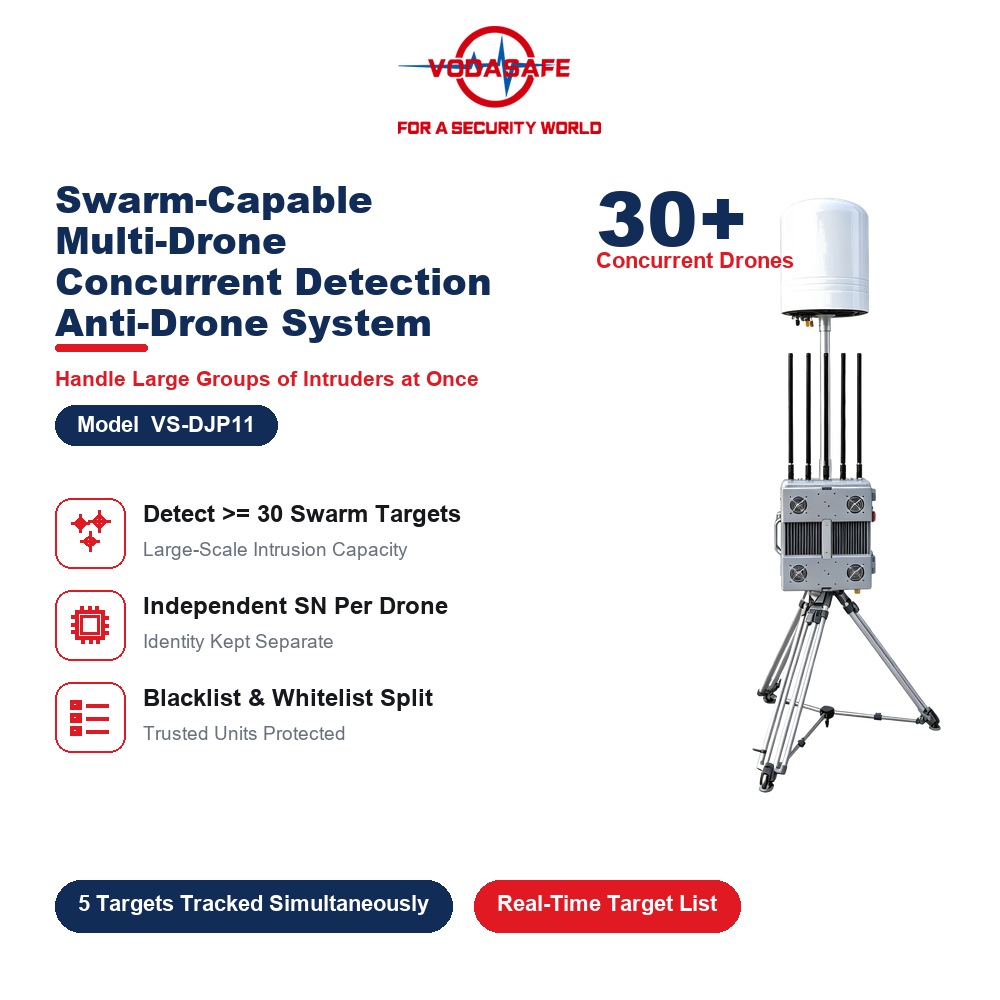
Typical Application Scenarios
· Government and military core zones: garrisons, confidential research institutes and central government compounds.
· Critical infrastructure: nuclear power stations, hydropower plants, transformer substations, refineries and chemical parks.
· Large public events: international tournaments, national exhibitions, political summits and outdoor concerts.
· Transportation hubs: civil airports, high-speed railway stations and port container terminals.
· High-sensitivity venues: prisons, courts, hospitals and school campuses.
· Temporary mobile security: VIP escort protection, emergency disaster sites and temporary border patrol points.
After-Sales, Warranty and OEM/ODM
Vodasafe provides a complete after-sales system for the VS-DJP11 series. The whole machine carries a standard 24-month warranty covering all hardware modules except consumable antennas and cooling fans; free remote technical support covers platform training, installation guidance and real-time fault diagnosis over the network.
· Free firmware and drone-model-database upgrades within the warranty period; remote online identification-library expansion for newly released drones, with no hardware replacement required.
· Custom secondary development for enterprise clients: API adaptation, multi-platform linkage and localized UI language changes according to regional supervision requirements.
· Professional on-site installation and operation training on request, covering erection, platform operation, alarm rule configuration, log export and routine maintenance.
· OEM and ODM cooperation is supported.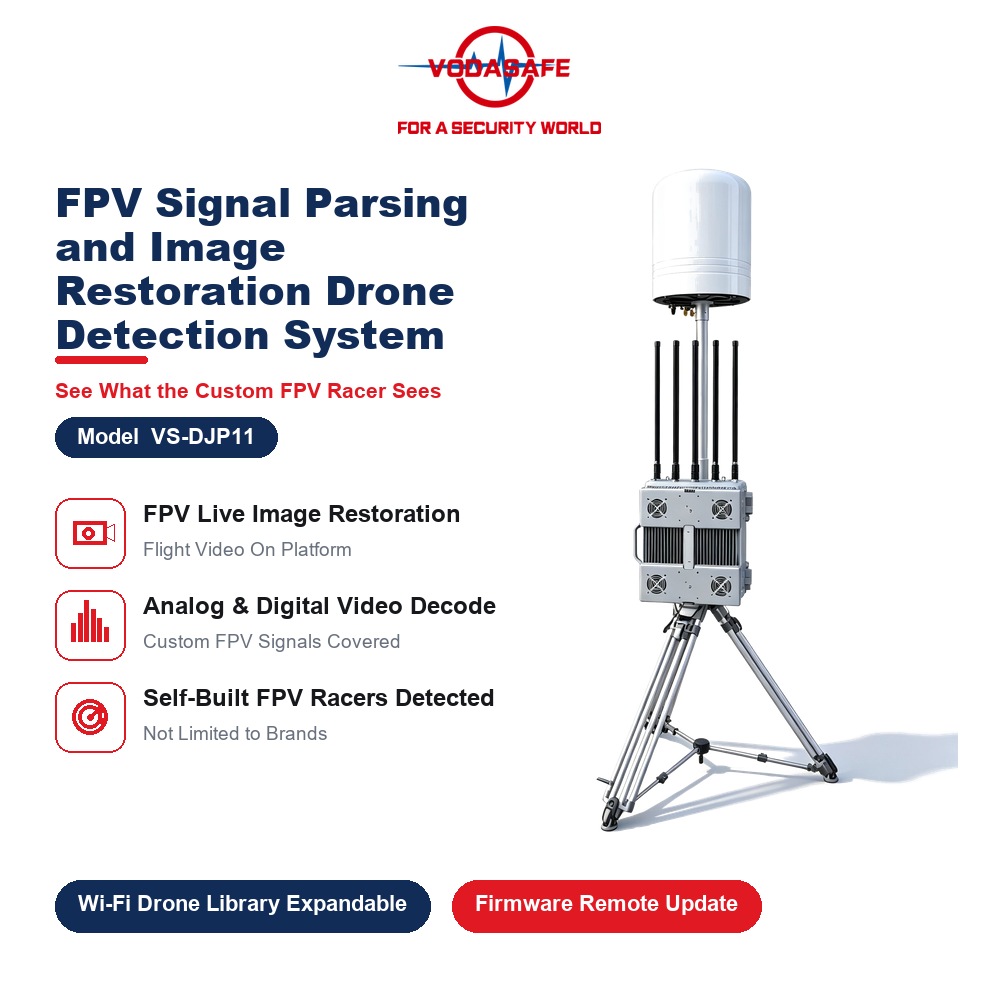
Technical Specifications
|
Category
|
Parameter
|
Specification
|
|
Detection System
|
Detection frequency band
|
100 MHz – 6 GHz
|
|
Detection System
|
Detection altitude
|
0 m – 1500 m
|
|
Detection System
|
Effective detection range
|
2 km – 6 km (varies with terrain, protocol and drone type)
|
|
Detection System
|
Swarm detection capacity
|
≥ 30 drones simultaneously
|
|
Detection System
|
Detection mode
|
Passive RF detection, zero surveillance emission
|
|
Detection System
|
Recognized drone models
|
More than 1000 models; DJI, Autel, Dahua, Yuneec, FIMI, self-built FPV and Wi-Fi drones
|
|
Direction Finding and Localization
|
Direction-finding frequency band
|
2 GHz – 6 GHz
|
|
Direction Finding and Localization
|
Simultaneous direction-finding targets
|
≥ 5 drones
|
|
Direction Finding and Localization
|
Direction-finding accuracy
|
≤ 1° RMS
|
|
Direction Finding and Localization
|
Direction-finding refresh interval
|
≤ 2 s
|
|
Direction Finding and Localization
|
Single-station localization accuracy
|
≤ 5 m
|
|
Direction Finding and Localization
|
Recordable flight trajectories
|
≥ 5 drones
|
|
Remote ID
|
RID detection range
|
1 km – 2 km
|
|
Remote ID
|
RID standards
|
ASTM F3411; ASD-STAN prEN 4709-002; GB42590-2023
|
|
Remote ID
|
RID technical protocols
|
Wi-Fi NAN; Wi-Fi Beacon
|
|
Countermeasure System
|
Countermeasure channels
|
4 independent omnidirectional channels
|
|
Countermeasure System
|
Channel 1
|
915 MHz: 915±5 MHz – 917±5 MHz
|
|
Countermeasure System
|
Channel 2
|
2.4 GHz: 2400±5 MHz – 2483.5±5 MHz
|
|
Countermeasure System
|
Channel 3
|
5.2 GHz: 5150±5 MHz – 5320±5 MHz
|
|
Countermeasure System
|
Channel 4
|
5.8 GHz: 5725±5 MHz – 5850±5 MHz
|
|
Countermeasure System
|
Average power per channel
|
42 ± 2 dBm
|
|
Countermeasure System
|
Coverage angle
|
360° omnidirectional
|
|
Countermeasure System
|
Simultaneous countermeasure targets
|
≥ 25 drones
|
|
Countermeasure System
|
Effective countermeasure range
|
0.5 km – 2 km
|
|
Countermeasure System
|
Response time after target confirmation
|
≤ 2 s
|
|
Countermeasure System
|
Countermeasure targets
|
Remote-control downlink; video / transmission uplink
|
|
Mechanical
|
Detection unit weight
|
≤ 15 kg
|
|
Mechanical
|
Detection unit base diameter / overall height
|
420 mm / 555 mm (including connectors)
|
|
Mechanical
|
Countermeasure cabinet weight
|
≤ 30 kg (antennas excluded)
|
|
Mechanical
|
Countermeasure cabinet dimensions
|
461 × 298.4 × 515.8 mm
|
|
Mechanical
|
Packed weights
|
Detection unit ≤ 25 kg; cabinet ≤ 40 kg; full set ≤ 120 kg
|
|
Electrical
|
External power supply
|
220 V AC, 50 / 60 Hz
|
|
Electrical
|
Standby power consumption
|
≤ 70 W
|
|
Electrical
|
Maximum power consumption
|
≤ 800 W (all channels active)
|
|
Electrical
|
Data backhaul
|
Wired Ethernet and wireless router; dual network ports
|
|
Environmental
|
Protection rating
|
IP66
|
|
Environmental
|
Working temperature
|
−40 °C to +55 °C
|
|
Environmental
|
Storage temperature
|
−40 °C to +70 °C
|
|
Environmental
|
Surface treatment
|
Anti-rust and anti-corrosion coating on metal structural parts
|
|
Deployment
|
Deployment modes
|
Portable tripod (two operators, about 30 minutes); fixed steel frame
|
|
Service
|
Warranty and cooperation
|
24-month warranty; OEM / ODM supported
|